If your organization sends email from multiple sources, getting your email architecture right is one of the most important decisions you can make. Get it wrong and you are mixing risk, muddying your sender reputation, and making it nearly impossible to diagnose problems when they surface.
There are two primary frameworks I recommend to organizations in this situation. Both are valid. Which one you choose depends on your risk profile, volume, and operational maturity.
Approach 1: Isolation and Segmentation
The first approach is clean separation. You isolate each mail stream based on its risk level and silo it using a combination of subdomains or dedicated domains and dedicated IP ranges.
Think of it like lanes on a highway. Transactional mail goes in one lane. Marketing goes in another. Promotional cold outreach or anything riskier sits in its own lane entirely. No crossover. No cross contamination.
This works because mailbox providers evaluate sender reputation at the IP and domain level (as well as many other layers). If one stream runs into trouble, the damage stops there. Your transactional mail keeps flowing. Your reputation on the primary domain stays protected.
The tradeoff is operational overhead. You are managing multiple domain and IP configurations, separate authentication setups, and potentially separate sending infrastructure. For organizations with technical resources and high stakes around deliverability, this overhead is worth it.
Approach 2: Traffic Stacking
The second approach is what I call stacking. Instead of fully isolating mail streams, you intentionally blend a controlled percentage of riskier traffic into a high-reputation foundation.
The ratio matters here. I cap the riskier traffic at 10 to 15 percent of total volume, with 20% as an absolute ceiling. The foundation should be your most reputable sends: emails going to people who actively requested them, like download confirmations, order updates, or opted-in welcome sequences. Traffic that drives strong engagement signals.
You then blend a smaller volume of riskier sends on top of that foundation. The engaged recipient base and consistent positive signals carry the weight, keeping the overall stream healthy.
This approach requires discipline and close monitoring. The moment riskier traffic starts dominating the mix, the strategy breaks down. Mailbox providers are pattern matchers. If they see engagement decay, complaint upticks, or inconsistency, reputation issues follow quickly.
Which Approach Is Right for You?
Use isolation when your streams have clearly different risk profiles, your technical team can manage the complexity, and you need clear accountability for each sending channel.
Use stacking when your volume does not yet justify full infrastructure separation, your “riskier” traffic is only modestly risky, and you have strong engagement signals from a reliable base audience to anchor the blend.
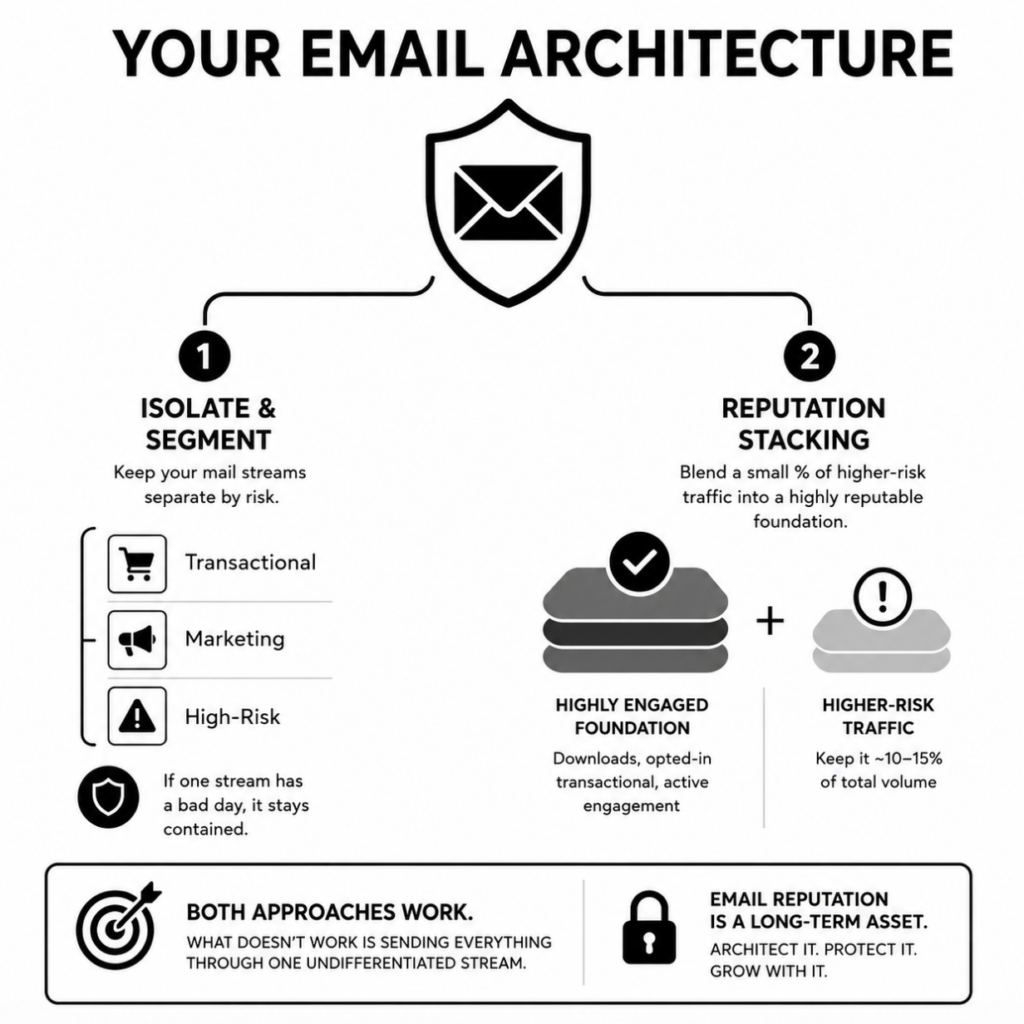
In both cases, the underlying principle is the same: protect your reputation assets and contain risk. The architecture is just the mechanism you use to do it.
If you are unsure which applies to your situation, the answer is usually: start with isolation, and only consider stacking once you have a clear view into your engagement baseline.