Most companies are thinking about email deliverability the wrong way.
Not because they’re careless.
Because the industry has taught them a fundamentally flawed mental model.
I had the chance to present this idea at the keynote at the Deliverability Summit 2026 in Barcelona.

The conversation in that room reinforced exactly why this mindset shift matters.
The dominant framing goes something like this: deliverability is a problem that surfaces when something goes wrong. You hit a spam filter, your open rates crater, you call your ESP, you run through a checklist, and you fix it.
Incident detected. Incident resolved.
The problem is that’s not how email actually works.
And as long as companies operate with that mindset, they’ll keep finding themselves in the same place: reacting to problems that were built into their system long before they became visible.
Here’s the shift that changes everything:
Email is not just a channel. It’s infrastructure.
And infrastructure has to be actively “owned“.
The Inconsistency Problem Nobody Talks About
Here’s a scenario most email marketers have lived through.
You send a campaign that isn’t your best work. Engagement drops. Maybe complaints tick up slightly. You feel it—and you make a note not to do it again.
Now consider this: two companies send that same bad campaign.
One recovers in a day.
The other struggles for weeks.
Same mistake. Completely different outcomes.
So the question worth asking isn’t “was this a good campaign or a bad campaign?”
It’s: why did the system react the way it did?
The answer almost never lives in the campaign itself. It lives in the infrastructure underneath it.
Strong infrastructure absorbs a bad send. Weak infrastructure amplifies it.
That’s not a campaign optimization problem. That’s a systems problem.
The Checklist Trap
The deliverability industry has gotten very good at solving for visible problems.
SPF. DKIM. DMARC. Warmup. Audience segmentation. List hygiene.
These matter. They’re important. And if you’ve been doing email long enough, you’ve probably got a version of this checklist somewhere.
But here’s the uncomfortable truth: most of the problems companies are trying to fix were already baked into the system before anyone ran a single check.
Campaigns don’t just create outcomes. They reveal the strength (or weakness) of your infrastructure.
A good campaign sent on a weak foundation will underperform.
A bad campaign sent on a strong foundation will recover quickly.
This reframes the entire conversation. It’s not about fixing deliverability when it breaks. It’s about building and maintaining the system that holds everything together.
Three Realities Most Teams Don’t Fully Reckon With
1. Systems Fragment as Companies Scale
This one is almost universal.
A company starts sending from one ESP. Then they add a second for transactional email. Then product starts sending in-app notification emails. Support sets up automated sequences. A partner integration starts firing its own campaigns.
At some point, nobody has a complete map of what’s being sent (or from where).
And here’s the critical detail: all of those sending streams are often sharing the same reputation.
Marketing is sending. Product is sending. Support is sending. Sales is sending. All independently. All contributing to the same trust signals that mailbox providers are evaluating.
You can’t control what you can’t see.
2. Reputation Is Shared by Default
Infrastructure doesn’t isolate itself. It aggregates.
Your reputation is shared across domains, subdomains, IPs, and sending systems. Strong performance in one area can be dragged down by a problem in a completely different part of the stack—one that nobody is actively watching.
What’s actually being traded here is trust.
And the dangerous part is that mailbox providers are evaluating your entire footprint, not just the campaign you’re optimizing this week.
Reputation is shared by default. Isolation must be intentional.
If you haven’t explicitly designed your email infrastructure to separate risk by purpose, audience, and behavior, you haven’t done it.
3. Infrastructure Is Not Static
This is the one most teams underestimate.
Email infrastructure isn’t something you set up once and then manage with occasional check-ins. It’s a living system that changes constantly.
New tools get added.
New sending sources come online.
Engagement patterns shift.
Volume scales.
Signals move well before problems become visible. By the time performance drops, the root cause often traces back weeks or months—to something that changed quietly and without anyone noticing.
Most teams don’t find out something broke until performance drops. Because they’re not managing a system. They’re reacting to symptoms.
What Email Infrastructure Actually Is
When most teams talk about their “email setup,” they’re describing:
- An ESP
- A few DNS records
- Maybe a dedicated IP
That’s not wrong. But it’s a fraction of what email infrastructure actually encompasses.
Email infrastructure is the full system that governs how your email is sent, trusted, evaluated, and delivered. It spans multiple layers—and the more layers you’re not actively operating in, the more unpredictable your outcomes become.
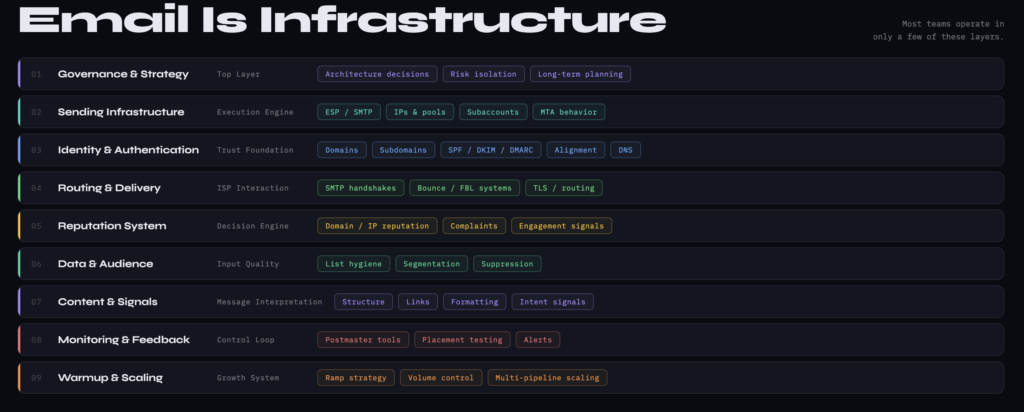
Those layers include:
Governance and strategy. Who owns email outcomes? What are the standards across teams and tools?
Sending infrastructure. Your ESPs, IPs, domains, sending streams.
Identity and authentication. SPF, DKIM, DMARC, BIMI—the signals that establish who you are.
Routing and delivery. How your email moves from server to inbox, and where it can go wrong.
Reputation systems. How mailbox providers are scoring you across engagement, complaints, and sending history.
Data and audience. The quality, consent, and health of your list.
Content and signals. What your emails look like to filters, and what behavioral signals they trigger.
Monitoring and feedback. Postmaster tools, FBLs, bounce handling, alerting.
Warmup and scaling. How you introduce volume, new domains, and new streams over time.
Most programs operate in two or three of these layers. The ones that consistently win operate across all of them.
The more of the system you don’t own, the more your outcomes are decided for you.
This Is Not a Deliverability Problem. It’s an Ownership Problem.
Here’s the frame shift that matters most.
Every time I work with a company that has a chronic deliverability problem, the same root cause surfaces: nobody owns the system.
There’s often an ESP vendor who manages the tool. A marketing ops person who runs the campaigns. A developer who set up the DNS records two years ago. Maybe a deliverability consultant who gets called in when things break.
But nobody sees the full picture. Nobody is accountable for outcomes across the entire infrastructure over time.
And because nobody owns it, nobody sees it when it quietly starts to fail.
By “owned,” I don’t mean monitored occasionally or audited once a year. I mean actively managed—by someone who:
- Sees every sending source
- Manages reputation across the full stack
- Detects issues before they become performance problems
- Makes intentional decisions about risk isolation and scaling
This is a different role than a deliverability expert. Different from an ESP operator. Different from a campaign strategist.
It’s an email infrastructure owner.
And for most companies at scale, this role either doesn’t exist, or it’s split across too many people to be effective.
What This Looks Like in Practice
Owning your email infrastructure comes down to four things:
Visibility. Know every source that’s sending email on behalf of your brand. Not just your main ESP. All of it.
Isolation. Separate sending streams by risk profile. Transactional and marketing shouldn’t share a reputation if they don’t have to. High-value and re-engagement audiences don’t belong in the same stream.
Ownership. There should be a named person or team accountable for infrastructure outcomes, not just campaign metrics.
Awareness. Active monitoring with real alerting. Signals change before symptoms appear. If you’re only looking at performance dashboards, you’re already late.
None of this requires a massive overhaul. But it does require a different way of thinking about what email actually is.
The Companies That Will Win With Email
This isn’t about better campaigns.
It never was.
The best-performing email programs I’ve seen don’t win because they write better subject lines or A/B test more aggressively. They win because they’ve built a system that is resilient, visible, and actively managed.
A bad campaign hurts them less because the foundation is strong.
A new tool or sending source gets integrated intentionally, not haphazardly.
Problems are caught early, before they compound.
The inbox has a memory. Mailbox providers are tracking trust signals continuously, not just during your sends.
Companies that treat email as a channel will keep chasing deliverability as a problem to solve.
Companies that treat email as infrastructure will build something that compounds over time.
If you’re not actively managing your system, you’re reacting to it.
And in email, reactive is expensive.
Want to talk through what this looks like for your program? Get in touch.